

With more than half of the operational offshore support vessel fleet now over 15 years old, the industry faces the practical challenge of keeping existing vessels efficient, reliable and commercially credible while fleet renewal remains selective. Measured vessel data offers a route to extend competitiveness by improving fuel performance, supporting maintenance decisions, strengthening compliance reporting and giving charterers clearer evidence of operational performance.
The fleet you have is the fleet you will run
The offshore support vessel market has entered a new phase. Across the global OSV market, the replacement pipeline remains limited compared with the size of the active fleet, and recycling has slowed from previous highs. This means many older vessels are likely to remain in service for longer.
This matters because age is no longer only a technical concern. It is a commercial condition. Older vessels are being asked to work longer, meet tighter charterer expectations and provide stronger evidence on fuel, emissions and operational performance. At the same time, many owners cannot rely on rapid fleet renewal. Newbuilding prices, yard capacity, balance sheet discipline and uncertainty over future fuels all make replacement a selective rather than universal answer.
For much of the offshore sector, therefore, the central question is not simply when the fleet will be replaced. It is how existing vessels can be run better, longer and with proof. Digitalisation is one practical answer to that question when it is treated as a fleet life extension strategy built on measured data, trusted baselines, exception based monitoring and clear operational follow up. The issue is not whether older vessels can continue operating, but whether their performance can be demonstrated with enough confidence to satisfy owners, charterers and regulators. Although this article focuses on fuel and commercial performance, the same measured data foundation also supports safety, through earlier visibility of machinery anomalies, more consistent operating procedures and verifiable operational records.
Age compounds risk across the vessel lifecycle
An ageing vessel can still be a strong commercial asset, but age increases the need for evidence based management. Technical risk rises through equipment degradation, sensor drift, propulsion inefficiency and obsolescence in control and DP systems. Operational risk appears through more downtime, missed charters and less predictable performance. Commercial risk follows when charterers compare older tonnage with newer vessels and ask for assurance that fuel consumption, reliability and emissions can be demonstrated rather than promised. Analysis published by S&P Global in 2023 illustrated the stakes, putting utilisation of vessels under ten years at 75 per cent against 48 per cent for older units.
All four risks eventually land in the P&L. The owner of an older vessel needs to know whether higher fuel burn is caused by hull condition, engine condition, operating practice, sensor error, weather, loading or simply the way the vessel is being used. Without measured data, the answer is often anecdotal. With measured data, the answer can become specific enough to act on.
This is where digital solutions become an operational approach rather than a technology label. A digital system can connect vessel sensors, secure ship to shore data transfer, analytics and decision workflows, but its value depends on the decisions it supports. It allows the owner to monitor fuel and machinery performance continuously, compare similar vessels fairly, identify deviation early and document improvements. The value is not the data itself. The value is the ability to turn data into credible action.
Digitalisation as fleet life extension
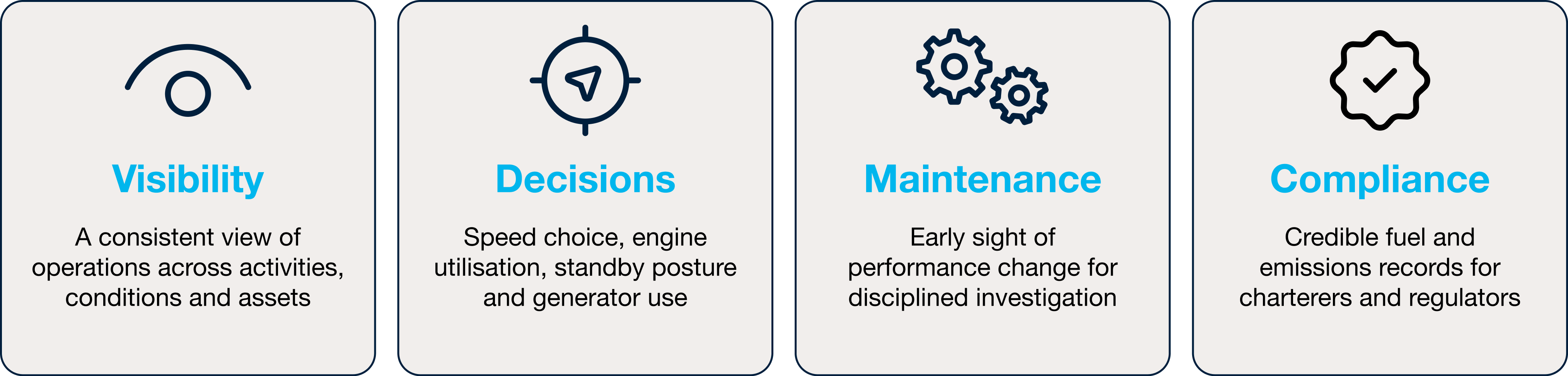
For an ageing OSV fleet, digitalisation has four practical roles (Figure 1). First, it creates visibility by giving owners a consistent view of how vessels are operating across different activities, conditions and assets. Second, it improves decisions around speed choice, engine utilisation, standby posture and generator use. Third, it strengthens maintenance planning by highlighting performance changes early, so owners can investigate potential hull, machinery or sensor issues before they become larger problems. Fourth, it supports compliance and assurance by producing credible fuel and emissions records.
This is why digitalisation should be framed not as an optional add on for modern tonnage, but as a practical mechanism for older vessels. It helps owners extract more value from the assets they already have.
Putting the digital pathway into practice
The most powerful benchmark in an ageing fleet may already be inside the fleet itself. Sister vessels offer a practical starting point because they make comparison more meaningful. When vessels share a similar design, machinery and operating purpose, persistent differences in performance become easier to investigate. For an ageing fleet, this is especially useful because it helps owners separate what may be linked to vessel condition, sensor reliability or operating practice, and focus attention on areas that can be improved.
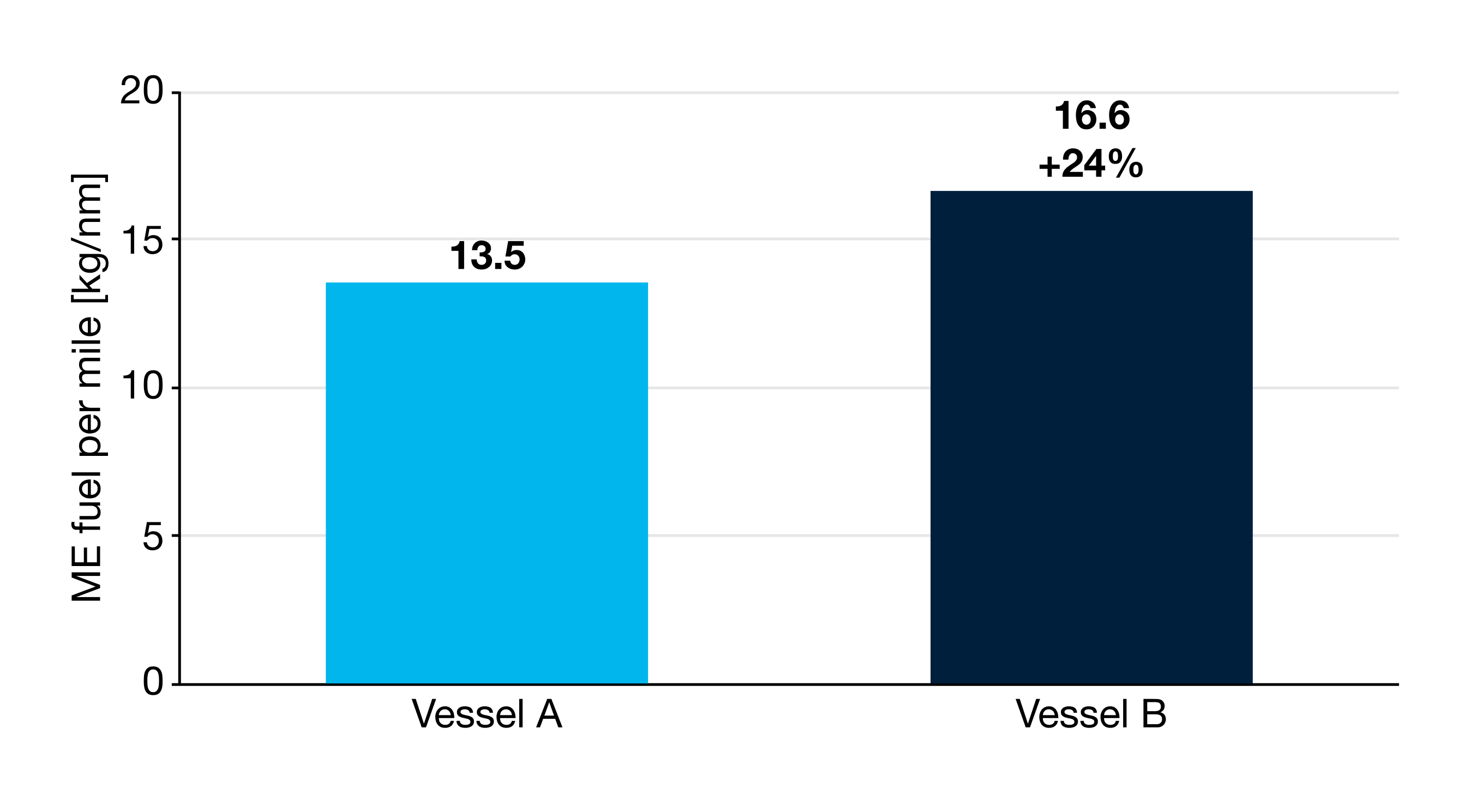
An illustrative analysis of two sister offshore support vessels operating in the same Gulf waters shows what measured data can reveal. The vessels shared the same design and machinery configuration, and their fuel use was measured directly rather than inferred from manual reporting. The analysis covered more than a year of vessel operation and included fuel, speed, position, activity state and weather context.
The comparison delivered a clear headline. Across the same service speed band of 11 to 14.5 knots in calm water, the sister vessels differed by 24 per cent in median fuel per nautical mile, as shown in Figure 2. The result highlights an important point for ageing fleets. Part of a performance gap may be linked to operating practice.
The preparation of the data was as important as the volume. Records that did not pass validation checks were excluded before analysis, and identical rules were applied to both vessels. Performance curves were built only from steady speed periods to avoid acceleration effects, and sufficient spread across time was required so that one unusual voyage could not be mistaken for normal behaviour.
This makes benchmarking more than a subjective comparison. It becomes an operational tool. The purpose is not to blame one vessel or one crew. It is to identify where performance differs, decide whether the cause is condition, practice or measurement, and then take the next practical step.
Activity based benchmarking across the fleet
A second insight came from activity based comparison rather than purely transit fuel performance. Standby and manoeuvring are routine operating modes, but the data showed that fuel consumption and engine configuration could vary significantly between sister vessels working in similar conditions, as Figure 3 shows. This was not only a question of fuel use. It showed that operational instructions, bridge routines and engine management practices can differ materially across the fleet, even when the vessels are technically comparable.
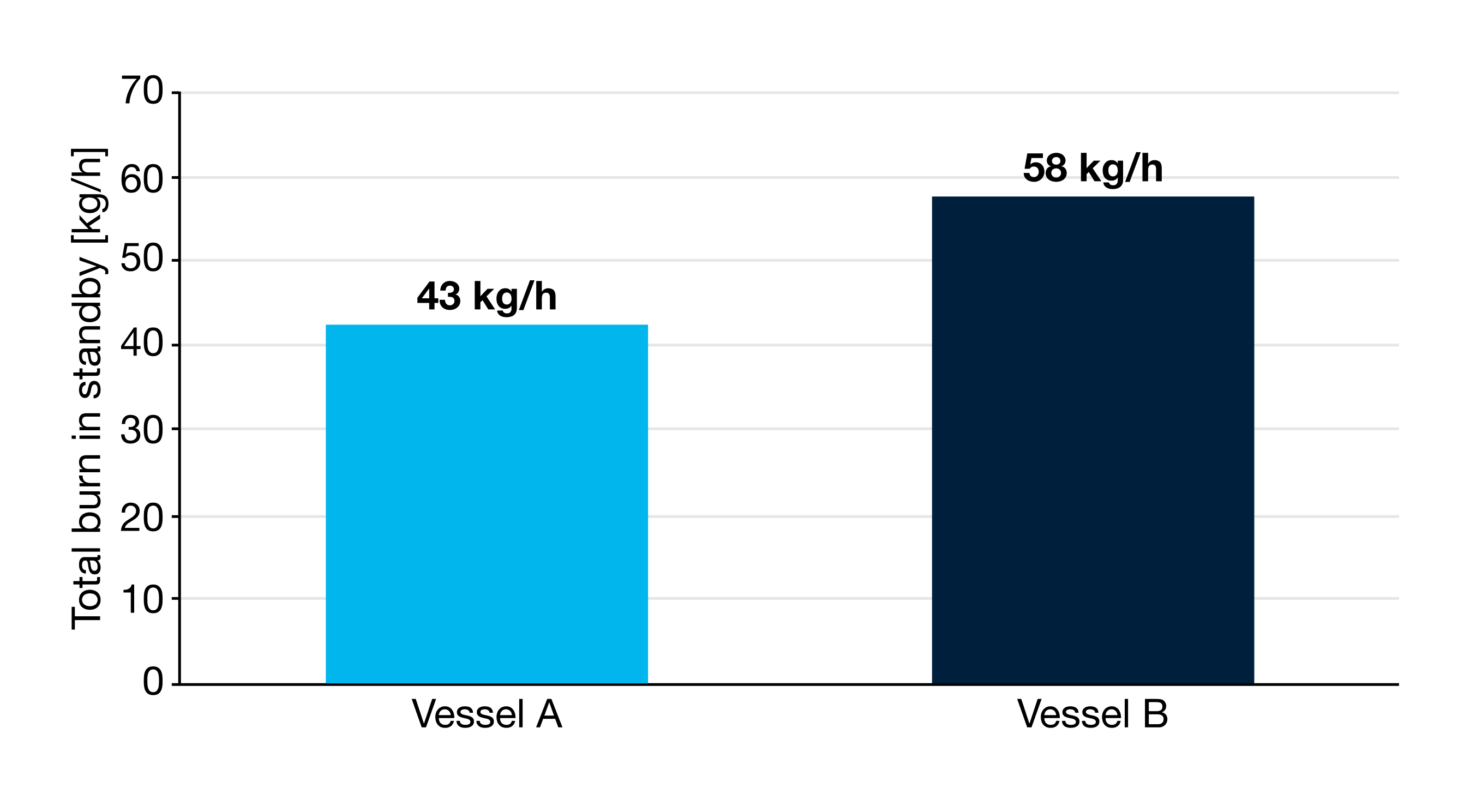
Activity based benchmarking helps owners move from isolated observations to fleet wide best practice. In this example, the comparison showed a material opportunity to reduce fuel consumption, emissions and operating cost by reviewing standby engine configuration and operating instructions. The analysis indicated that routine operating modes can deliver measurable value when assessed consistently, with potential annual savings that were commercially meaningful even before considering wider benefits such as lower emissions and more consistent procedures. The purpose is not to decide that one vessel is right and another is wrong, but to use measured evidence to compare practices, understand the reasons for variation and decide which approach should be applied more widely across the fleet. The practical next step for the pair is to align standby operating instructions and verify the change in the following months of measured data, so that the improvement is demonstrated rather than assumed.
Performance trends provide maintenance evidence
When performance indicators are tracked consistently over time, they can show when a vessel’s efficiency changes materially. A noticeable improvement or deterioration can then be compared with maintenance records, hull cleaning dates, operating conditions or changes in vessel loading. In this way, digital data helps owners understand whether an intervention has delivered measurable value, not only in technical terms, but also in fuel saved, emissions avoided and cost reduced.
A more detailed engine profile can also help owners understand whether a performance change is linked to machinery behaviour, vessel condition or measurement quality. When one sister vessel begins to behave differently from another, the first step should be to check instrument health and compare operating profiles before drawing conclusions. This helps owners avoid acting on the wrong signal and supports more disciplined investigation of root causes.
Measured performance is becoming a commercial asset
None of this is available with the same confidence from noon reports alone. Reported fuel consumption and measured fuel consumption can diverge materially, and manual reporting seldom provides the granularity needed to separate transit, standby, manoeuvring, dynamic positioning and port activity. An older vessel competing for work needs more than a claim that it is efficient. It needs a record that shows how it performs, where it has improved, how exceptions are managed and how performance is being controlled over time.
This matters in charter discussions. Charterers are under growing pressure to understand the fuel and emissions profile of contracted tonnage, while owners need to demonstrate that existing assets can meet operational, environmental and assurance expectations. Measured data helps shift the conversation from assumptions about vessel age to evidence about vessel performance. For owners, digital systems are therefore not simply a box to tick for tender eligibility, nor merely an internal efficiency tool. They become part of the commercial offer, with data that can be trusted, performance that can be proved and a credible pathway for keeping existing vessels competitive.
The OSV fleet will not be renewed overnight. Older vessels will continue to support offshore energy operations, and many will remain valuable assets if they can show reliable, efficient and transparent performance. Digitalisation is not a substitute for good seamanship, maintenance or investment. It is the mechanism that connects them. In a market where age, efficiency and assurance increasingly shape commercial decisions, the vessels best positioned for the future may not simply be the newest. They may be the vessels whose performance can be measured, managed and proved.
Unlock the full potential of your ageing fleet
Ageing vessels don't have to mean declining performance. With the right data, insights and operational expertise, you can identify opportunities to improve efficiency, reduce fuel consumption and emissions, and extend the operational life of your fleet.
Want to discover how GTT Marine can help you improve the performance of your ageing fleet?
Get in touch with our team at sales@gttmarine.fr to explore how we can support your fleet performance goals.